Azzato has been selling, renting and repairing instruments in Brussels and Louvain-la-Neuve since 1919. The project replaced the old site with a full catalogue, wired to the shop's management software, and with three tools that each answer one specific question before the visit.
- Client
- Azzato
- Role
- Website, catalogue and online tools
- Year
- 2026
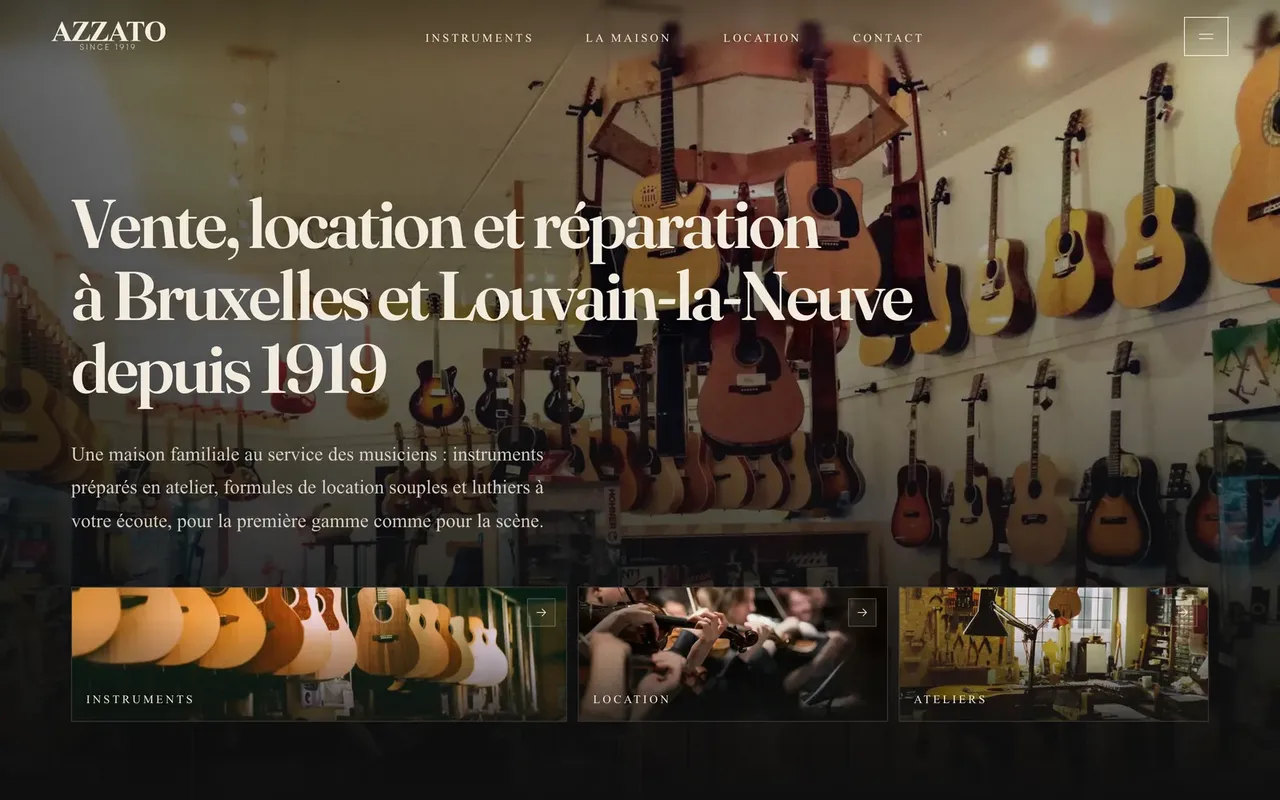
The house has two shops, a workshop and a team of ten, luthiers and sales advisers. It does not sell online, and that is a choice: an instrument is tried, listened to and chosen in your hands. So the site was not meant to be a shop. It had to show what is actually on the shelves, at the real price, and give people a reason to come through the door. Everything else in the project follows from that constraint, down to the connection with the shop's management software.
The price on the site is the price at the till
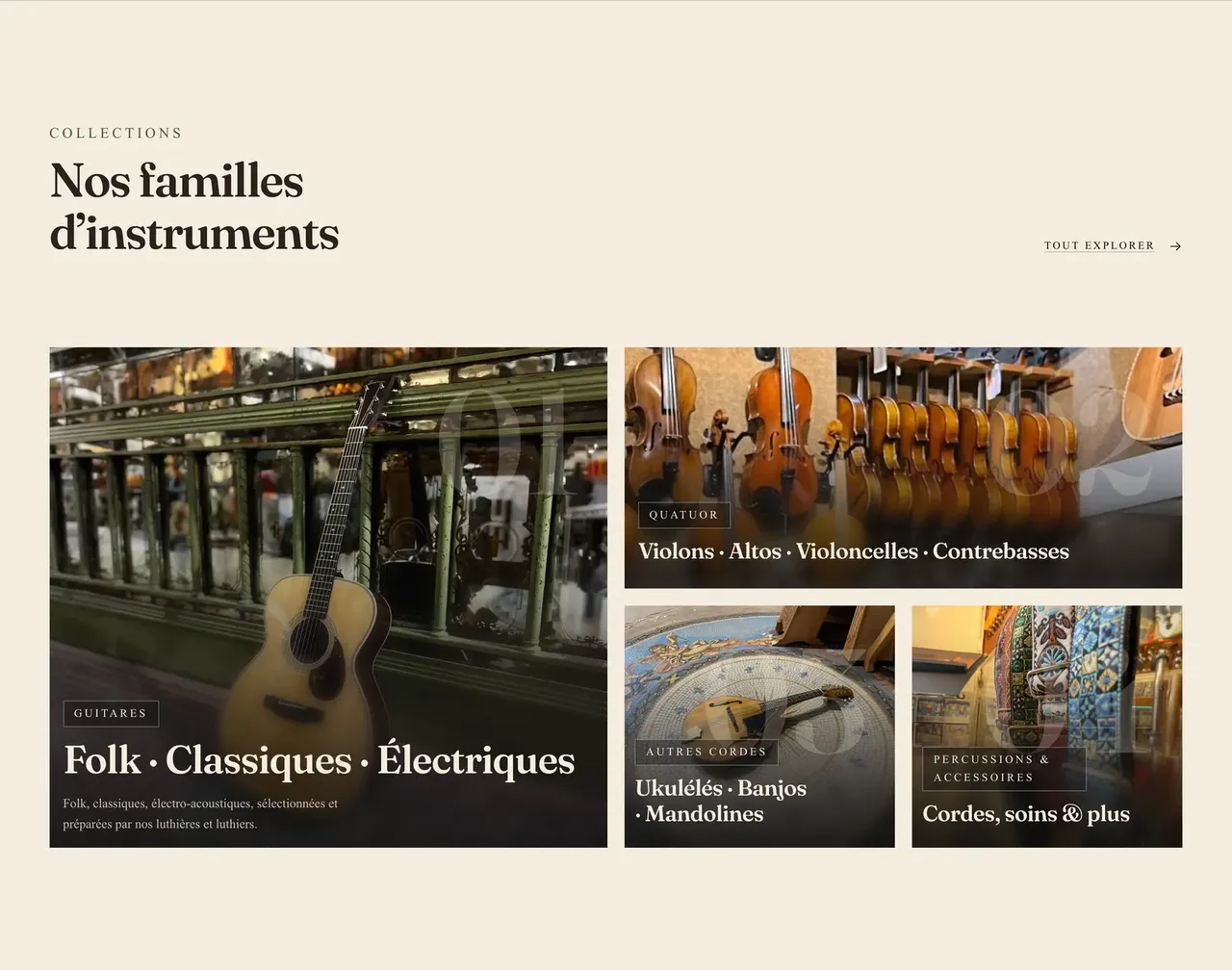
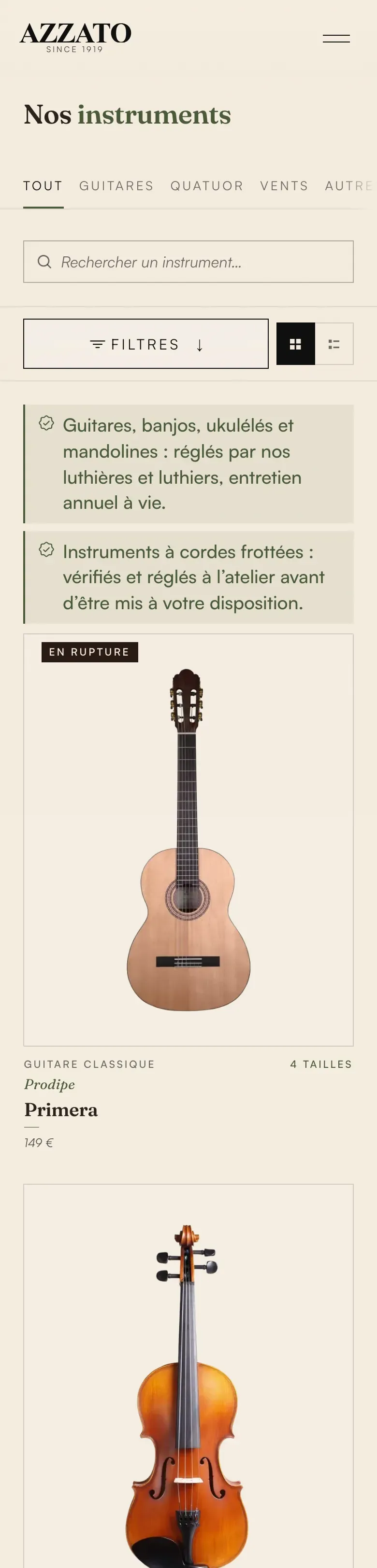
Every instrument page carries the ID of its item in Mercator, the shop's management software. That link is what lets the site show a price without anyone copying it by hand. A comparison rerun on every export flags the gaps between the site and the software, and the team decides, because a selling price remains a commercial call. At the shop's request, the pages dropped their introductory paragraphs in favour of a proper spec sheet: around ten characteristics on median, taken from the manufacturers' own sites. Photos follow a measured rule, the instrument fills at least 85% of the height of its frame, so the catalogue grid stays readable from one model to the next.
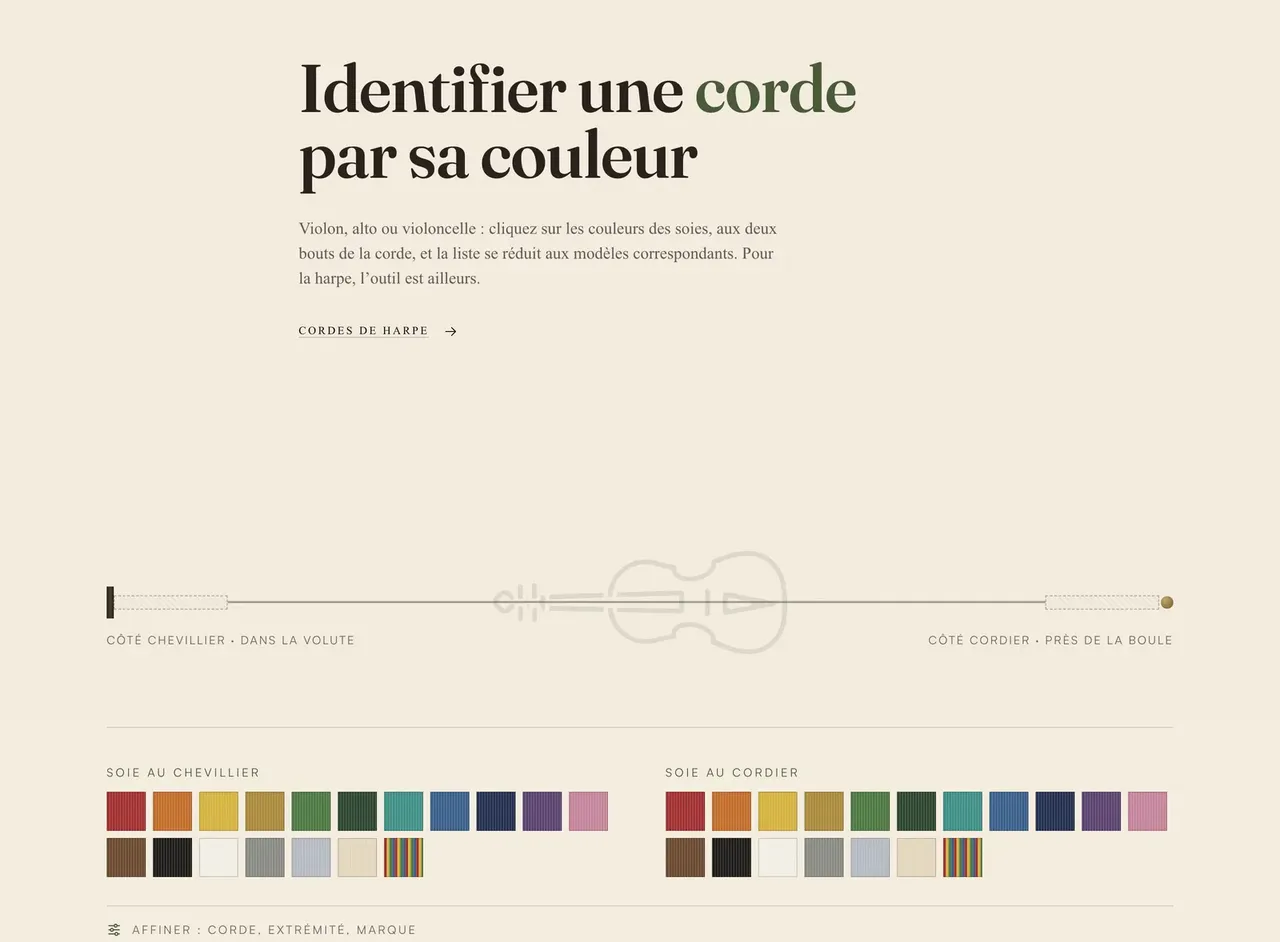
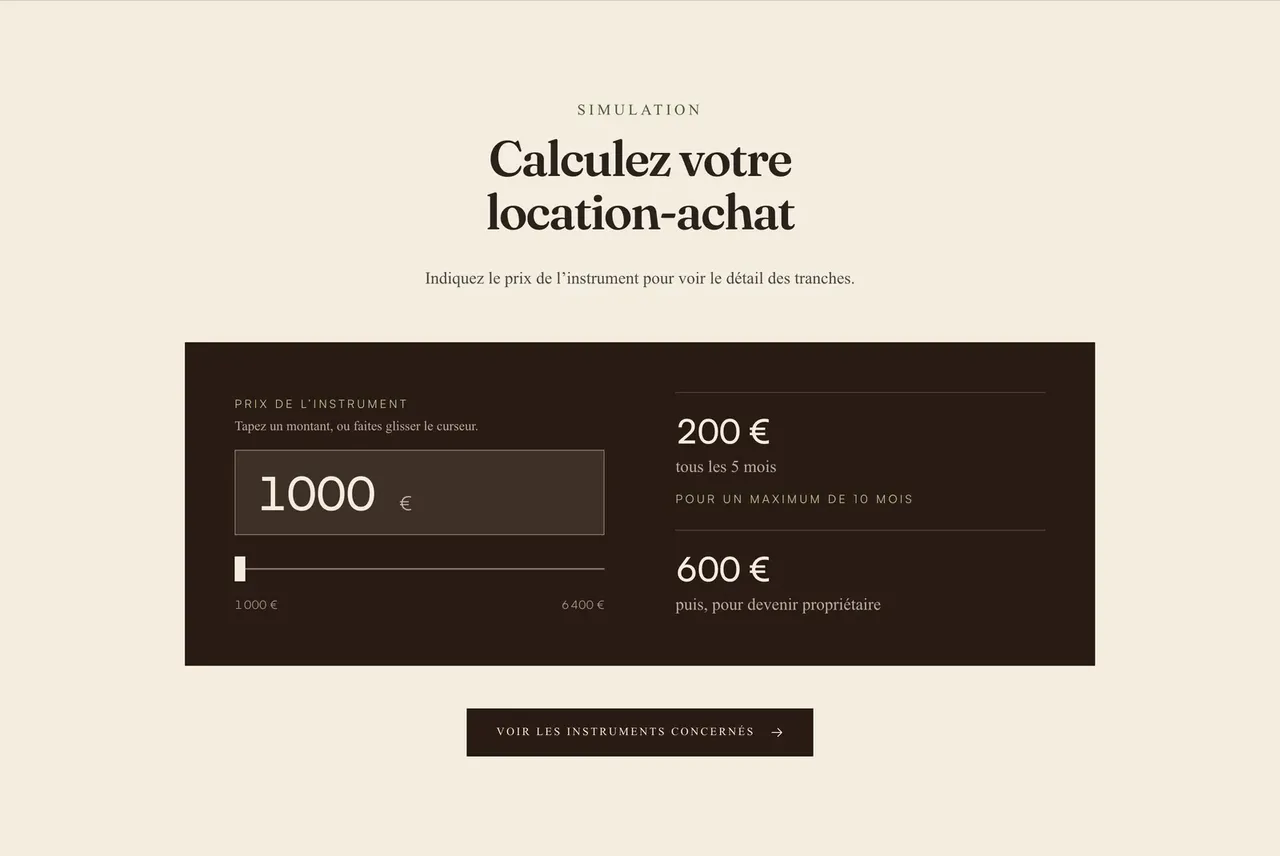
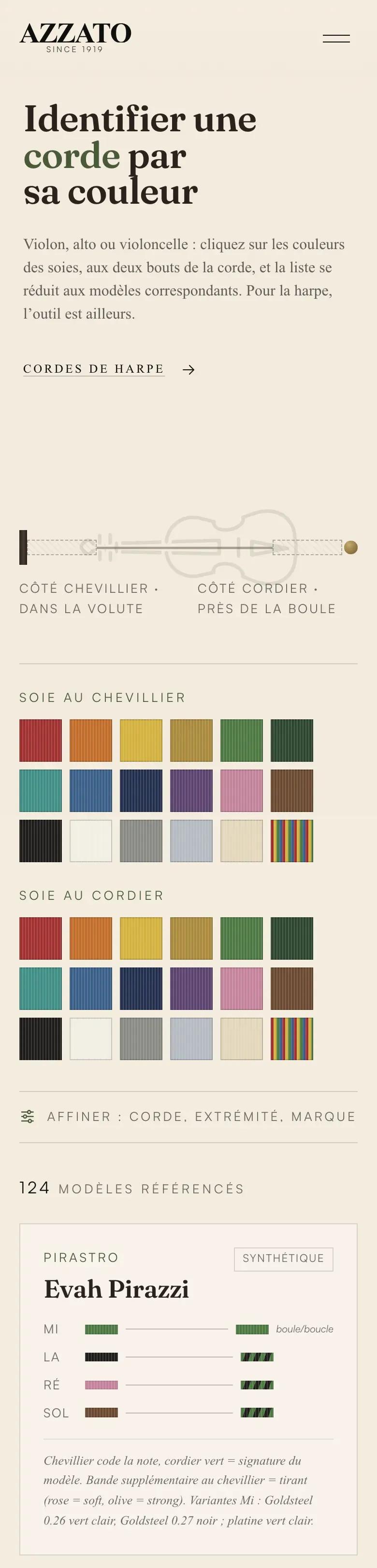
Three tools answer questions people ask themselves before walking in. The orientation quiz takes five questions, who it is for, which family, what music, what level, what budget, and points to instruments that are actually in the catalogue. The string finder starts from a gesture every violinist knows: looking at the colour of the silks at both ends of the string. You click those colours, the list narrows down, and if nothing matches, the tool suggests bringing the string into the shop. Finally, the rent-to-own simulator works out the instalments for instruments from €999, with limits taken from the catalogue's real prices. The maps of the two shops were removed along the way. They could not be moved or zoomed, loaded 34 requests and close to 300 KB from four third-party domains, and sent every visitor's IP address to a map tile provider. A photo of the shopfront and a directions button do the job better: you recognise the shop when you get there. The art direction stays restrained, ivory, espresso brown and olive green, the latter kept for statuses such as "Second-hand". Between two pages, a metronome keeps you company.
The site is built in French, Dutch and English, and each language only opens to indexing once it has been proofread. The old WordPress addresses redirect to their equivalents, so nothing search engines already knew is lost. And each shop is described separately in the structured data, with its own address, because a business with two addresses that only declares one ends up misplaced on the map.
- Custom website, from design to development
- Catalogue connected to the Mercator management software
- Technical instrument pages, sourced from manufacturers
- Five-question orientation quiz
- String finder based on silk colours
- Rent-to-own simulator
- Dutch and English versions
- Redirects for the old site's addresses
- Admin for prices, stock and copy
What the site carries today
The site has been serving azzato.eu since September 2026. The figures below are dated readings, not projections.
- instrument pages online, reading of 28/09/2026
- 459
- string models identifiable by their silks
- 124
- mobile LCP, real visitors (CrUX, 19/09/2026)
- 2,0 s
- mobile INP, real visitors (CrUX, 19/09/2026)
- 116 ms
Measured from 19/09 to 28/09/2026
Visit azzato.eu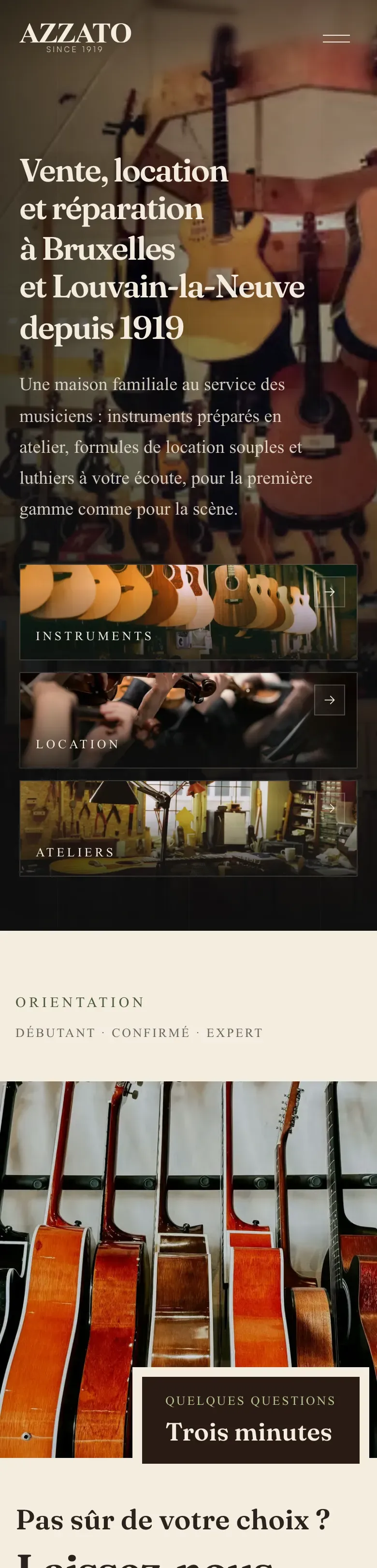

Before, during, after: the same method on every project
See our expertise · Web Design & Development Let's talk about your project- Before
Discovery
We get to know the project, ask our questions and talk it through with you.
- Before
Inspiration and direction
We gather inspiration and set a direction with you, before anything gets created.
- During
Creation
The heart of the project, paced by regular back and forth with you.
- After
Delivery and testing
We deliver, then check with you that everything works.
- After
Handover and adjustments
We train you and help you get to grips with the material. Your feedback is taken on board to fine-tune it.